

What Causes Backlight Leakage in iPhone LCD Screens?
Backlight leakage in replacement iPhone LCD screens can come from a problem inside the display assembly, mechanical stress introduced during handling or installation, or damage that occurs after the screen has already left the factory. For wholesale buyers, repair chains, and distributors, what actually needs answering isn't a dictionary definition of the defect - it's whether a specific unit or batch points to a manufacturing issue worth raising with a supplier, or to damage picked up somewhere downstream. This article covers what causes backlight leakage, how to separate the two possibilities with reasonable confidence, and how to build that check into sample approval and incoming inspection before it turns into a return or a warranty dispute.
What Is Backlight Leakage?
An LCD panel doesn't produce light at the pixel level - the image is formed by liquid crystal cells modulating light coming from a backlight unit behind them, spread evenly across the panel by a light guide and diffuser layers. Backlight leakage happens when some of that light escapes where it shouldn't: typically along one or more edges of the screen, in a corner, or as a faint glow visible around the bezel when the display shows a dark or black image.
It shows up most clearly in a dark room with the screen displaying a solid black or near-black background. On a normal panel, black should look reasonably uniform edge to edge. Leakage appears as a lighter patch or band that doesn't match the rest of the display - sometimes subtle, sometimes visible even with the room lights on. It's a uniformity problem, not a color or brightness calibration issue, and the two are worth telling apart before assuming a defect: uneven color temperature or dimness across the panel has its own separate set of causes.
What Causes Backlight Leakage?
Backlight leakage generally traces back to one of two broad categories: something introduced during manufacturing and assembly, or something introduced after the panel was built. The split matters because it points to a different next step - a supplier conversation in one case, a handling review in the other - and it's one of the patterns that runs through most common iPhone LCD defects and their root causes, not just this one.
Manufacturing and assembly-related causes can include:
- Uneven pressure applied during lamination or panel bonding, which can shift the light-guide plate slightly out of position
- A reflector or diffuser layer that isn't fully aligned within the module
- Frame or bezel tolerances that leave a small gap where light can escape at the edge
- Adhesive or foam gaskets around the backlight assembly that are inconsistent between units
Mechanical stress and handling-related causes can include:
- Pressure applied to the screen during installation - particularly around the edges, where a light guide can shift even without visible cracking
- Bending or flexing the panel during removal of an old screen or fitting of a new one
- Impact or drop damage after installation, which may not crack the glass but can still disturb the internal layers
- Improper packaging or rough handling in transit, especially for screens shipped without adequate edge protection
A patch of light along one edge can look identical whether the light guide shifted during lamination or during a technician's install. For buyers, this is why a documented inspection process carries more weight than judging a single photo or a single unit.

Manufacturing Defects vs Installation Damage
Appearance alone rarely proves where backlight leakage came from - no single visual marker reliably separates a factory issue from handling damage. What shifts the likelihood one way or the other is a combination of context and pattern:
- Timing. Leakage visible in a sample screen before it has been installed anywhere points toward manufacturing. Leakage that appears only after an install, a drop, or rough handling points the other way.
- Pattern across units. A single unit showing leakage out of a large batch is more consistent with an isolated handling issue. The same leakage pattern appearing across multiple units from the same batch is more consistent with a manufacturing or assembly cause.
- Physical condition. Cracked glass, a bent frame, or visible impact marks near the leakage area point toward mechanical damage. A clean, unmarked screen with leakage present out of the box points away from it.
- Whether the problem follows the screen or the device. Where a second compatible unit is available, testing the same screen in another device - or installing a known-good screen in the original device - settles more disputes than a visual check alone. Leakage that travels with the screen across devices points to the screen; leakage that disappears with a different screen but persists on the same device points to the device or to how the screen was installed.
| Observation | More Likely Explanation | What to Check | Evidence to Record |
|---|---|---|---|
| Leakage visible before the screen has been installed anywhere | Manufacturing or assembly issue | Sample condition and batch record | Photos of the sample, plus model and batch number |
| Leakage appears only after installation | Installation-related pressure or handling | Installation technique and physical condition of the unit | Photos of frame and glass condition, installation notes |
| Same leakage pattern across several units from one batch | Batch-level manufacturing issue | Batch consistency and supplier QC records | Number of units affected, batch number, comparison photos |
| Leakage alongside a bent frame or impact marks | Mechanical damage | Photos and physical inspection | Photos of the damage, shipping or handling notes |
| Leakage present out of the box with no visible physical damage | Requires further evaluation | Comparison against the approved sample, and a screen/device swap test if a second unit is available | Sample comparison photos, swap-test result |
None of these rows is a standalone verdict - a single row rarely settles a claim on its own, which is why distinguishing installation damage from a manufacturing defect usually takes more than one data point once a warranty claim or return is on the table and a supplier is going to ask what evidence supports it.
How to Check for Backlight Leakage Before a Bulk Order?
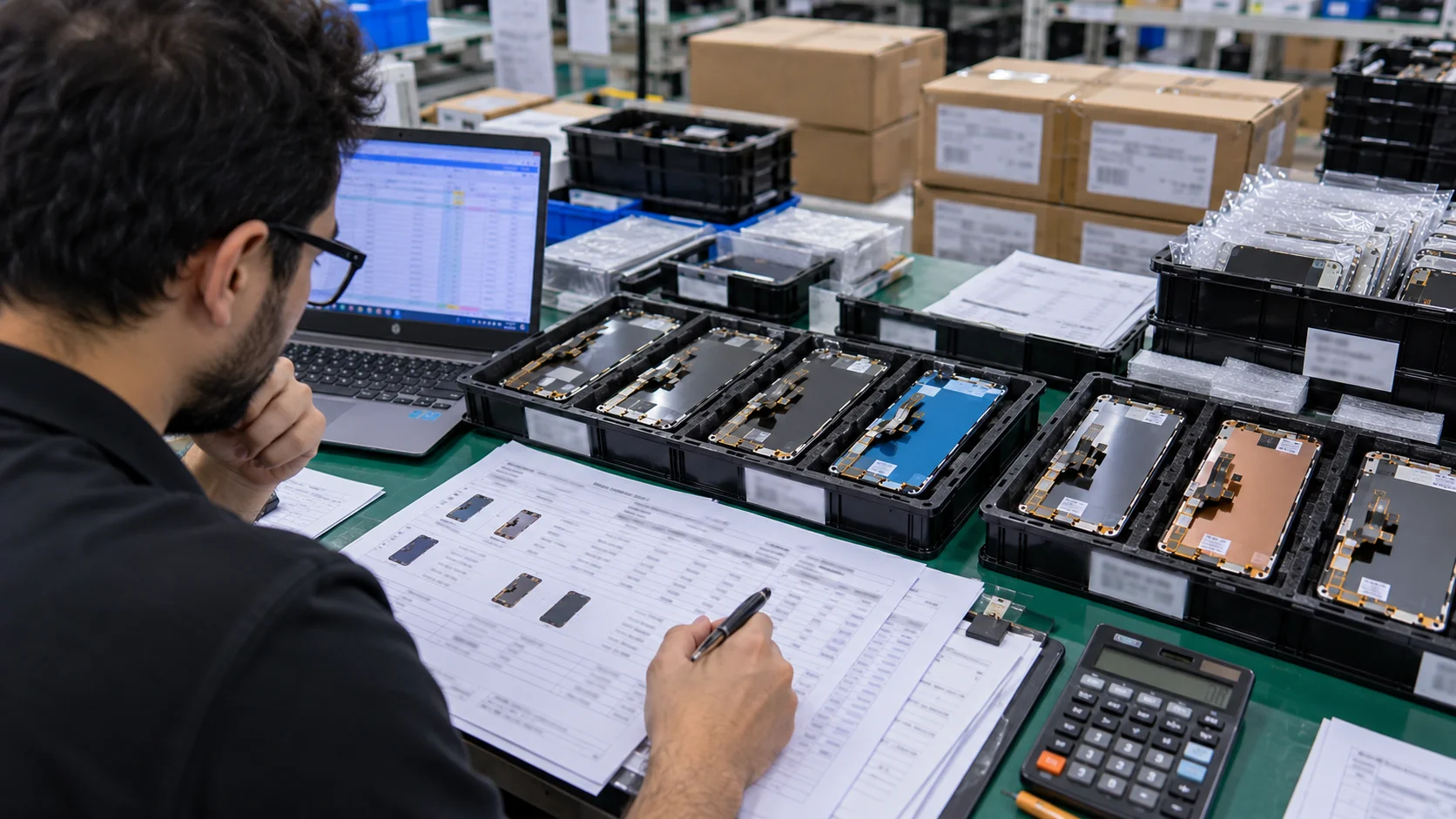
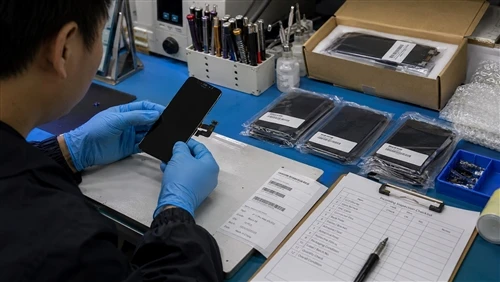
Sample evaluation is the point where backlight leakage is cheapest to catch - before quantities scale up and before the cost of a defect includes reshipping, labor, and a customer complaint. A practical process looks like this:
- Test in a dark or dimly lit room, not under normal office lighting.
- Display a solid black or near-black screen and let the panel settle for a few seconds before judging it.
- Check all four edges and corners, not just the areas that are easiest to see straight on.
- View the panel from a slight angle as well as straight on - some leakage is more visible off-axis.
- Compare more than one sample side by side instead of judging a single unit in isolation.
- Record which model, batch, and sample number was tested, along with photos of any area that shows unevenness.
- If a case is disputed and a second compatible device is on hand, repeat the test with the same screen in that device - a result that travels with the screen is stronger evidence than either party's first impression.
Photos alone can be misleading here: camera exposure in a dark room often exaggerates edge illumination well beyond what's visible to the eye, so photo evidence from either a supplier or a buyer is worth confirming with a live, in-person test under the same conditions whenever that's practical.
Buyers testing a supplier for the first time generally get more value from checking the specific model they plan to stock - for example, running this process on an actual iPhone 8Plus replacement LCD screen sample rather than a different model from the same product line, since backlight uniformity can vary somewhat between panel designs even from the same manufacturer.

How Wholesalers Can Check Backlight Leakage in Incoming LCD Shipments?
Sample approval establishes a baseline: it confirms that the units a buyer was shown meet expectations. It doesn't confirm that every unit in a later bulk shipment will match that baseline - that's a separate check, and incoming inspection is where it happens:
- Select a consistent sample size from each incoming shipment instead of checking whichever units happen to be on top of the box.
- Test under the same dark-room, black-screen conditions used during sample approval, so results are comparable.
- Compare incoming units against the approved sample, not just against a general impression of "acceptable."
- Record model, batch number, and quantity affected for any unit that shows leakage, so a pattern across a shipment is visible instead of treated as isolated cases.
- Flag results to the supplier with photos and batch references while the shipment is still traceable.
Without an acceptance threshold agreed with the supplier in advance, buyers end up judging each shipment case by case, which makes it harder to hold a supplier accountable for the batch as a whole. Buyers who already run dead pixel and backlight leakage checks as part of incoming QC can fold this directly into that same pass rather than treating it as a separate inspection, and the dead pixel and backlight leakage identification process covers the shared inspection setup in more detail.

Why Backlight Leakage Matters to Repair Businesses?
For a single unit, backlight leakage is an annoyance - a screen that gets swapped or returned. Across a batch, the cost compounds in ways that don't always show up until later. It's one of several defect patterns covered under reducing iPhone LCD return rates, and the mechanics are the same regardless of which specific defect is driving the return:
- Technician time spent diagnosing a complaint that turns out to be a display defect rather than an installation error
- Return shipping and restocking costs on units that already left the warehouse
- Customer complaints and rework on installs that already happened
- Warranty disputes where it isn't clear whether the defect was present before installation
- A supplier relationship that gets harder to manage once quality issues recur across multiple orders
None of this requires a high defect rate to matter. A small percentage of a large order is still enough units to create real labor and reputational cost, particularly for repair chains handling volume across multiple locations.
What Should Buyers Ask an iPhone LCD Supplier?
Before increasing order volume with a new or existing supplier, a short set of questions helps establish whether backlight quality is actually being controlled rather than assumed:
- How is backlight uniformity checked before screens are shipped - visually, under controlled lighting, or both?
- Are samples tested under the same conditions the buyer would use for incoming inspection?
- What information does the supplier need if a buyer reports suspected backlight leakage - batch number, photos, sample quantity?
- How are confirmed manufacturing defects handled under the agreed warranty terms?
- Is backlight consistency checked across the full batch, or only on a small number of units before shipment?
Model-specific inspection is worth raising directly in this conversation - a supplier's quality-control answer for iPhone 15Pro replacement LCD screens doesn't automatically apply to every other model in the catalog, and a buyer sourcing several models is better served asking the question per model than assuming one answer covers all of them.
The Question That Actually Matters
Most of the useful judgment in this article comes down to one shift in framing: stop checking whether a screen shows any visible edge illumination at all, and start checking whether the observed condition matches the approved sample and the quality criteria agreed with the supplier before the order was placed. Some degree of light at the very edge of a panel is common across LCD technology in general, so a screen isn't automatically defective because it shows a trace of it - but a screen that clearly falls outside what was approved is worth documenting even when the difference looks minor. For a wholesale buyer, the useful benchmark was never a theoretically perfect panel; it's agreement with the supplier, consistency with the sample, and consistency across the batch. Where a specific case still isn't clear after that comparison, the simplest tie-breaker is the one used throughout this article: test whether the leakage follows the screen or stays with the device, and let that result carry more weight than either side's first impression.
Common Buyer Mistakes When Evaluating Backlight Leakage
A few patterns show up repeatedly in how backlight leakage gets misjudged during procurement:
- Judging a single screen in isolation instead of comparing it against other samples from the same batch
- Inspecting under normal room lighting, where mild leakage is easy to miss
- Assuming any leakage found after installation must be a manufacturing defect, without checking installation handling first
- Skipping documentation - no photos, no batch reference - which leaves nothing to support a claim later
- Approving a sample without writing down what "acceptable" looked like, then having no baseline for the next batch
- Increasing order volume before confirming that quality stays consistent across a full production run, not just in the unit that was approved
Frequently Asked Questions
Is backlight leakage normal on an LCD replacement screen?
Minor edge illumination can occur on LCD panels generally. Whether a specific instance of visible backlight leakage is acceptable depends on the panel design, the testing conditions, the quality criteria agreed with the supplier, and how the unit compares against the approved sample - not on a fixed, universal standard.
What causes light leakage around an LCD screen?
It typically comes from either an assembly issue - a light guide, reflector, or bezel gap that isn't fully sealed - or mechanical stress introduced during installation, handling, or shipping. Both are covered in more detail above.
Can backlight leakage be caused during installation?
Yes. Pressure or flexing during screen removal and installation can shift internal layers even when the glass itself isn't damaged, which is part of why timing and physical condition matter when evaluating a reported case.
How can you tell whether backlight leakage comes from the screen or the device?
Where a second compatible device is available, test the same screen in it, or install a known-good screen in the original device. Leakage that travels with the screen points to the screen itself; leakage that disappears with a different screen but stays with the same device points to a device-side or installation-side cause. This works best alongside sample and batch comparisons, not as a substitute for them.
How should wholesalers test LCD screens for backlight leakage?
In a dark room, with a solid black or near-black test image, checking all edges and corners and comparing multiple samples instead of judging one unit on its own.
What should buyers do if backlight leakage is found in a bulk shipment?
Document the affected units - model, batch number, sample quantity, and photos - and report the findings to the supplier while the shipment is still traceable, before units are distributed further.
Where This Leaves Buyers
Backlight leakage isn't something inspection eliminates outright - it's something a buyer can catch earlier, document better, and hold suppliers accountable for more consistently. If backlight consistency is part of what's being evaluated for an upcoming order, the direct next step is to request representative iPhone LCD samples for quality evaluation, tested under the same dark-room conditions described above, before quantities scale up.