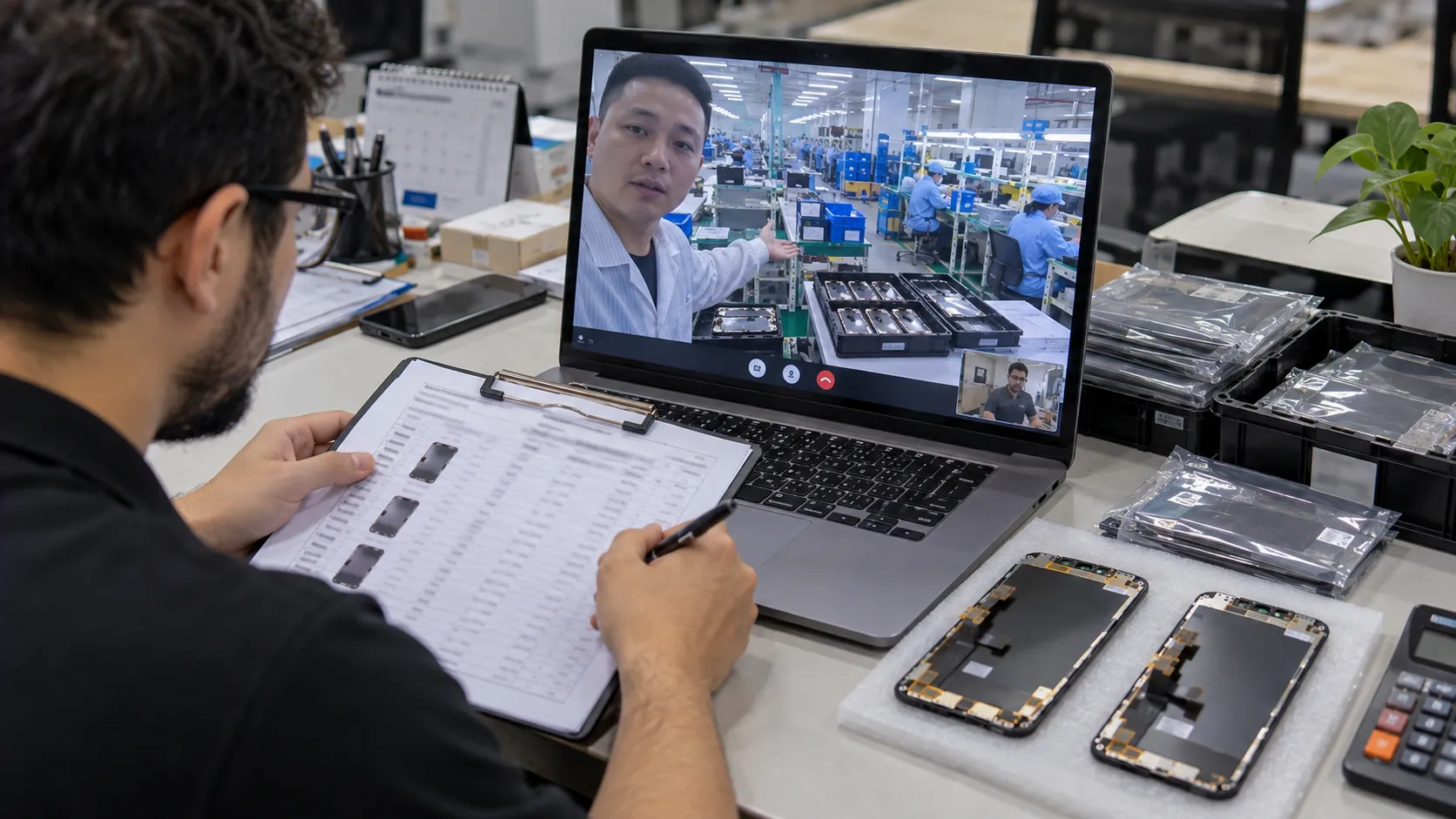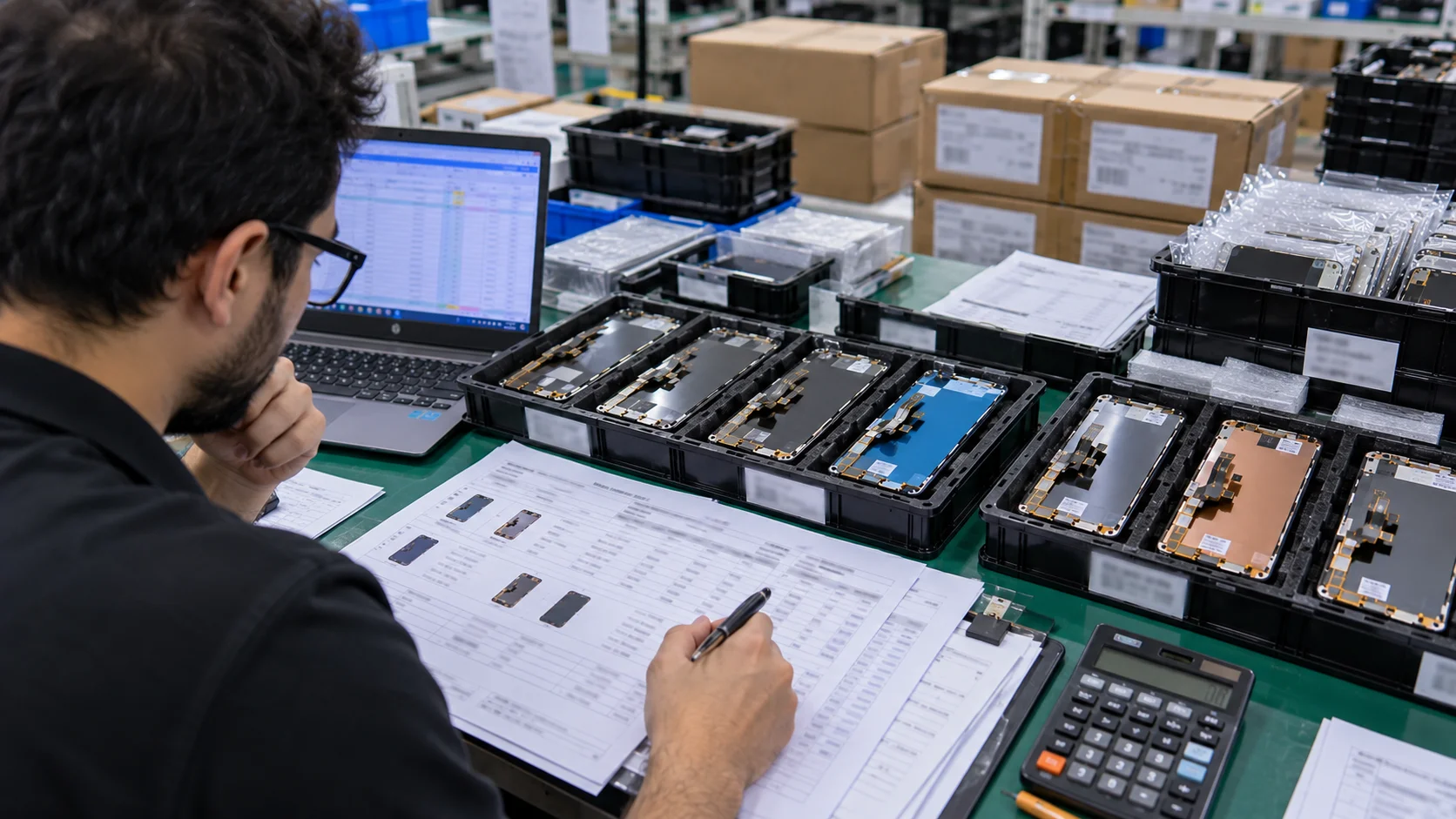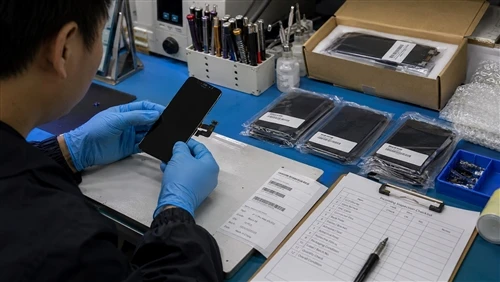


How to Audit an iPhone LCD Factory Remotely?
A remote iPhone LCD factory audit works when the video call is treated as a test of evidence, not a tour. A supplier can show a clean workshop, a row of testing stations, and a folder of certificates, and still leave the real questions open: which company is contracting with you, what does it actually control, and does anything on screen connect to the model you plan to order?
The workable method is an evidence chain: supplier claim, defined product, responsible process, live or documented evidence, traceable record, then your own sample verification. It is one layer of the broader iPhone LCD manufacturer evaluation framework, and its job is narrower than final approval. A remote audit can qualify or reject an iPhone LCD manufacturer before you spend money on samples, a trial order, third-party inspection, or an on-site visit.

What Can a Remote Factory Audit Actually Verify?
Within limits, quite a lot. A live call with well-prepared requests can verify or clarify:
- which company is contracting with you and whether it operates or controls the facility shown;
- what the supplier assembles, tests, inspects, reworks, packs, or outsources;
- how product references are identified and kept apart;
- how QC steps are run and recorded;
- how orders or batches are labeled, packed, and stored;
- whether staff can explain the process without a script;
- who is commercially responsible when a problem appears.
A remote audit cannot prove long-term batch consistency, future defect performance, every historical quality claim, upstream manufacturing activity, continuous compliance, or delivery performance. Whether sample quality carries through to bulk-order quality can only be answered by product and order verification. Remote evidence reduces uncertainty; it does not remove the need to check the product itself.
Prepare the Audit Scope Before the Video Call
Do not let the supplier set the whole agenda. Without a defined scope, you are likely to receive a polished general tour that answers very few purchasing questions. Before the call, write down the supplier claims that need verification, the exact iPhone models and product references involved, the assembly, testing, inspection, packaging, and warehouse steps that affect them, the documents and records the supplier should have ready, and the decision the audit supports (shortlist, sample request, wholesale quotation, trial order, or third-party inspection). Share the scope in advance without scripting the answers, and keep room for unplanned requests.
Verify Company Identity Before Evaluating the Factory
Start with who is on the other side of the contract. Collect the registered company name, business registration information, facility address, the entity that issues quotations and invoices, the website domain, and a named contact.
No single document settles factory-versus-trading-company status, and a registration record says nothing about what happens inside a building. The purpose here is narrower: establish which legal and commercial entity is communicating with you, then compare it with the entity that operates or controls the facility on camera. Names, addresses, or invoicing entities that do not line up need an explanation before the audit goes further.
Verify an iPhone LCD Manufacturer's Scope, Not Just the Word "Factory"
"Factory" tells you very little. Have the supplier sort each step into four groups:
- Handled directly: for example assembly, testing, inspection, rework, labeling, packing, warehousing.
- Sourced: components or sub-assemblies bought from other suppliers.
- Outsourced: processes performed by another company.
- Controlled but performed elsewhere: work done off-site to the supplier's specification and inspection.
Do not assume a replacement-screen supplier makes LCD cells, driver ICs, touch ICs, glass, or backlight components. Those are separate upstream activities, and the supplier should say plainly which ones it performs.
Outsourcing is not a defect. What matters is whether the supplier can define who is responsible for each step, control the specification, manage outsourced work, and remain accountable for the finished product. A supplier that explains an outsourced step clearly is easier to evaluate than one that claims everything is in-house and cannot show it.
Use a Live Video Walkthrough, Not Only Pre-Recorded Material
Photos, brochures, and edited videos are static evidence. A live walkthrough is stronger because the supplier must move through real spaces and answer requests it did not prepare for.
Depending on the facility, request views of the entrance or facility identification, receiving area, assembly area, testing or QC area, rework area, finished-goods area, warehouse, and packaging area. Not every facility has the same departments, so do not require a fixed layout.
Add a few reasonable, spontaneous requests: a walk from one area to the next without cutting the call, a product label on a current workbench, the same product reference in the testing area, the way a unit or batch is identified, and a record tied to current work where confidentiality allows. Leave unrelated customer information out of scope; the goal is to see process, not other buyers' orders.

Confirm the Footage Is Current and Relevant
A video call can still show old footage, a showroom, unrelated production, or another company's facility. No single technique is foolproof, so look for consistency across several: live navigation between areas, a current product reference shown on request, facility details that match the business information supplied, process questions put to the staff on screen, and a link between the product shown and your quotation or sample reference. A polished showroom is weak evidence of production responsibility, and a machine on camera does not show control of the process behind your product.
Follow One Product Reference Through the Process
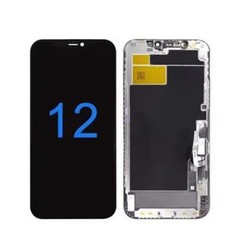
Instead of asking, "Can you show me your production line?", have the supplier follow one reference you may actually buy. If the quotation includes an iPhone 12 Pro LCD screen, the supplier should connect that exact reference to the specification, QC process, packaging label, and sample under discussion.
The path to follow:
Product reference → incoming or sourced components → assembly or processing scope → test and inspection → identification → packaging → finished inventory
A factory can look impressive and still tell you little about the screen being quoted. Display technology also differs by iPhone model, so have the supplier state the display type and specification of the exact product. Any step it cannot connect to that reference stays unverified, however good the surrounding footage looks.

Audit the iPhone LCD QC Process With Four Questions
Put four questions to every QC step the supplier claims:
- What is tested? Depending on the process: display function, touch response, visual condition, connector or flex condition, brightness or color-related performance, assembly condition, packaging condition. Not every factory tests all of these.
- Against what criteria? Check whether acceptance criteria are documented. Do not supply thresholds yourself.
- At what stage? Incoming, in-process, final, and pre-shipment checks answer different questions.
- How is the result recorded? An inspection sheet, digital record, batch record, QC label, or test log is stronger than a verbal answer.
"We test every screen" is a claim. A defined test method, an acceptance rule, and a record are evidence.

Ask for a Live QC Demonstration
Where feasible, request one relevant test on a current unit of a product you are evaluating. Observe:
- the device or fixture used;
- how the unit is identified before testing;
- what the operator checks;
- what counts as pass or fail;
- what happens to a failed unit;
- whether the result is recorded.
Seeing equipment does not show its calibration, accuracy, or certification. If calibration matters to your purchasing standard, request separate evidence.
Check How Nonconforming Screens Are Handled
How a supplier treats failures says more than how it treats passes. Look for how a failed unit is identified and separated from accepted product, whether rework is allowed and how reworked product is re-inspected, how recurring defects are reviewed, and whether a defect can be traced to a batch or process stage. The point is to learn whether failed product is controlled or simply retested until it passes.

Verify Product and Batch Traceability
In practical terms, traceability means the supplier can connect:
Product reference → batch or order → inspection information → packaging or label → shipment → later defect claim
Serial-level tracking is not a given. Batch-level, order-level, or label-level systems may be appropriate depending on the operation. What matters is that the link exists and can be demonstrated.
Put one direct question to the supplier: "If a problem appears after delivery, what information would you need from us to identify the relevant batch or production record?" The answer ties the audit to after-sales responsibility. A supplier that cannot answer will struggle to resolve a defect claim later.
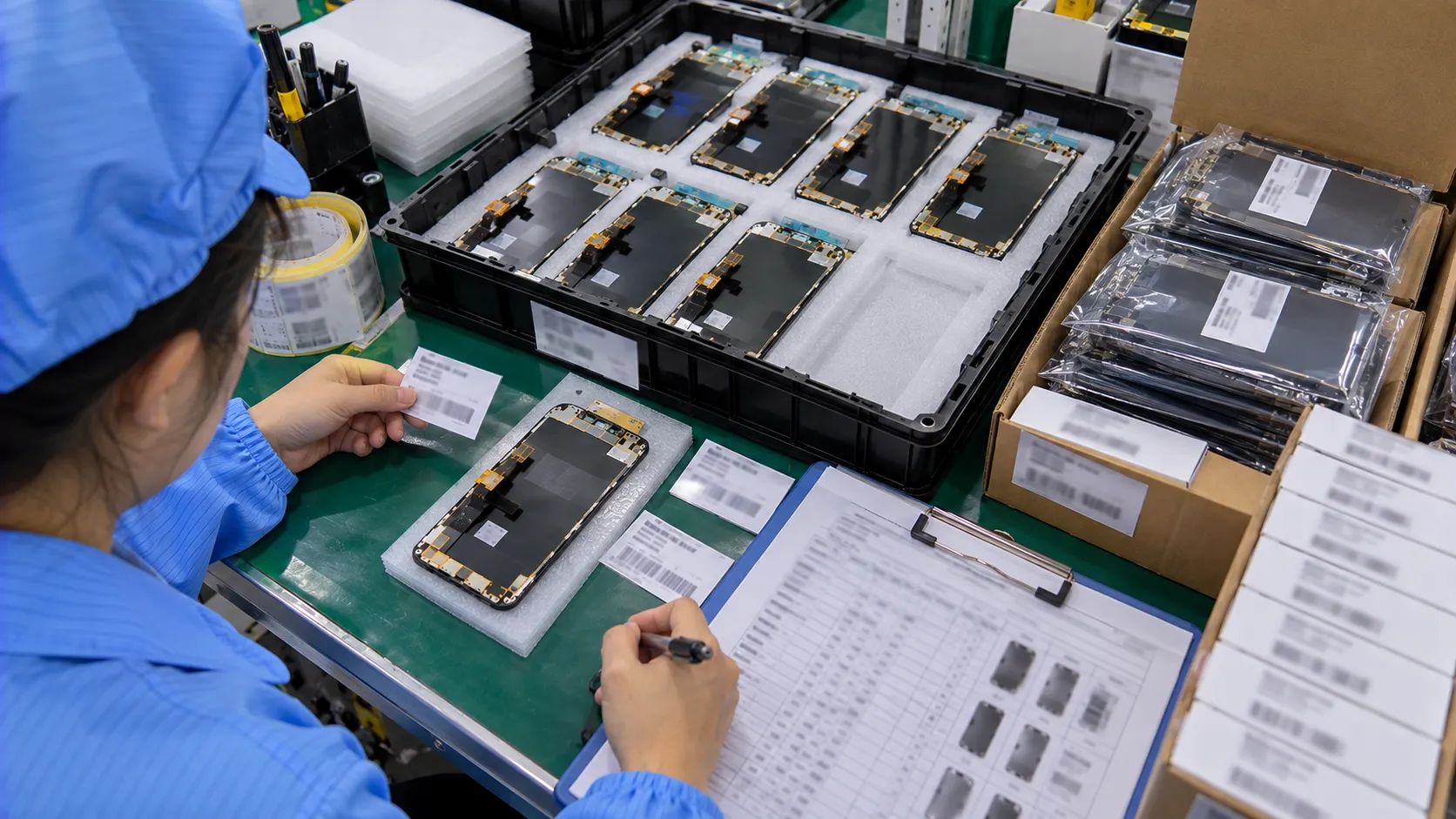
Review Documents, but Do Not Audit by PDF Alone
Documents support a remote audit; they do not replace one. Relevant items may include business registration, product specification sheets, QC procedures, inspection and batch records, calibration records, relevant certificates, packaging specifications, and a warranty or defect-handling procedure.
A document that exists is not necessarily a document that applies to your product. For each important document, establish:
- which company issued it;
- which product or process it covers;
- whether it is current;
- whether it can be connected to the supplier and product you are evaluating;
- whether key details can be verified independently where appropriate.
A certificate has limited value if you cannot connect it to the right company, scope, and current process.
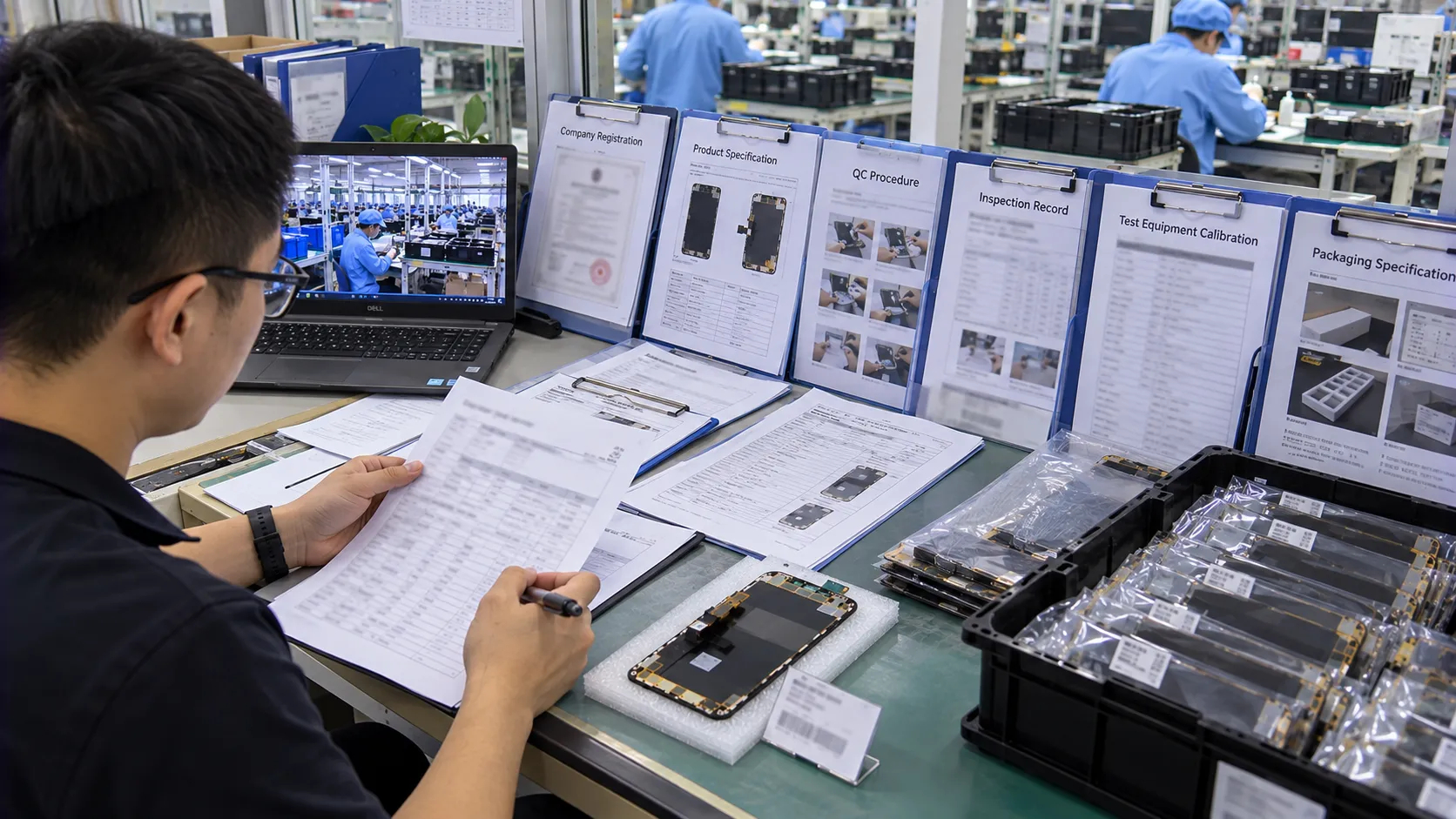
Convert Quality Claims Into Evidence Requests
Every sales claim can be turned into a request the supplier can answer with a demonstration, a record, or a written definition.
"Our screens have stable touch." Which touch test is performed, against what acceptance criteria, can it be demonstrated, and how is a failure recorded?
"Our batch consistency is good." How is the specification defined, how are production batches identified, what is checked between batches, and how are deviations handled?
"Our quality is original, OEM, or AAA." Which measurable specification and acceptance criteria sit behind that label?
Grade names deserve particular care. Terms such as AAA, OEM, original, copy, premium, high copy, in-cell, and "OEM quality" do not mean the same thing across suppliers. Some describe technical categories; others are supplier-specific marketing language. A label is weak evidence until the supplier ties it to a written specification.
Cross-Check What Sales Says Against What Operations Shows
Cross-checking is not about catching the factory lying; it tests whether statements, live observations, documents, labels, and samples tell the same story. The matrix turns each audit area into a decision. Its cells describe what to collect, not facts about any supplier.
| Audit Area | Supplier Claim | Evidence to Request | What to Cross-Check | Buyer Decision |
|---|---|---|---|---|
| Company identity | Manufacturer or supplier identity | Registration information plus live facility context | Names, address, contracting and invoicing entity | Clear / clarify |
| Manufacturing scope | Process handled directly | Live demonstration of the process | Staff explanation against the stated workflow | Verified / unclear |
| Product reference | Exact screen being quoted | Product label plus specification | Quotation, sample, and packaging | Matched / mismatch |
| QC | Defined testing | Live test, criteria, and record | Observed process against the document | Credible / incomplete |
| Traceability | Batch can be identified | Batch or order reference | QC record and packaging label | Traceable / unclear |
| Defect handling | Defined responsibility | Written workflow or policy | Warranty terms and batch linkage | Defined / clarify |
Distinguish Missing Information From a Real Red Flag
Not every incomplete answer means the supplier is unreliable.
Missing information or clarification needed
- A document must be retrieved, or one record is unavailable during the live call.
- Confidential customer information cannot be shown.
- An outsourced process needs a fuller explanation, or technical staff must answer later.
Potential red flag (unresolved contradictions, not single events)
- Repeated refusal to show relevant live areas without a reasonable explanation.
- Company identity and facility identity do not align and cannot be explained.
- Claimed in-house processes cannot be demonstrated or documented.
- Product references shown do not match the quoted product, or the sample specification cannot be tied to the quoted bulk product.
- QC claims change between sales and operations staff, or documents conflict with other supplied information.
- The supplier avoids defining responsibility for defects or outsourced processes.
One ambiguous moment is not grounds to label a supplier dishonest. Give the supplier a chance to close each gap in writing, and judge the pattern.
Score Evidence, Not Sales Confidence
Not all evidence carries the same weight. The table ranks it. It is an editorial framework for comparing evidence strength, not an industry certification scale.
| Evidence Level | Example | What It Can Support | Limitation |
|---|---|---|---|
| 1. Claim | Sales statement | Initial explanation | Unverified |
| 2. Static evidence | Photo, brochure, PDF | Background support | May be outdated or unrelated |
| 3. Live evidence | Real-time process shown | Current facility and process visibility | Still needs product linkage |
| 4. Product-linked evidence | Exact reference shown in process | Stronger relevance | Does not prove future consistency |
| 5. Traceable record | Batch or product linked to a QC record | Process accountability | Record quality must still be assessed |
| 6. Transactional verification | Sample, trial order, or inspection | Real supplied-product evidence | Limited to the tested or ordered scope |
A supplier that offers only levels 1 and 2 has given you background, not verification.
Remote Factory Audit Checklist
Identity and scope: contracting and invoicing entity; facility identity; responsible contact; in-house, sourced, and outsourced processes with a named owner for each.
Product: exact product reference; specification; labeling.
Operations and QC: relevant process flow; current work on the floor; operator knowledge; test item, acceptance criteria, stage, and record.
Traceability and documents: batch or order linkage to QC and packaging; documents that are product-linked, current, and consistent with what was shown live.
Commercial responsibility: sample terms; MOQ; lead time; warranty and defect handling; trial-order possibility.
What Should You Do After the Remote Audit?
The audit does not exist to award a factory a score. It sets how much purchasing exposure the evidence supports. Match what you collected to one of four outcomes.
Proceed to samples when identity is sufficiently clear, the manufacturing scope is understandable, the relevant processes were visible, the product specification can be defined, QC answers are credible enough for the next stage, and no major contradiction remains.
Request clarification when evidence is incomplete, documents need follow-up, responsibility for an outsourced process is unclear, or the link between product reference and process is partial.
Request additional verification when commercial exposure is high, key processes cannot be verified remotely, or your policy requires third-party review.
Stop or reconsider when major contradictions stay unresolved, supplier identity cannot be reconciled, claimed capabilities cannot be connected to evidence, or the supplier refuses reasonable product-specific verification without explanation.
Even a strong result leaves work for other methods: samples test the screen, a trial order tests execution, incoming inspection checks delivered goods, and a third-party or on-site audit may be justified where risk or value is high.
Use Samples to Test Whether the Remote Evidence Reaches the Product
A sample evaluates the product actually supplied to you, so connect it back to the audit:
Audited specification → sample product reference → sample identification → test result → quoted bulk specification
Before you test iPhone LCD samples before a bulk order, record which specification, product reference, and sample ID the supplier attached to each unit. A good sample validates the unit you received, not the consistency of future batches, so keep the audit notes beside the test results.
Use a Trial Order to Test Execution, Not Just Product Quality
A trial order shows what the audit cannot fully predict: order accuracy, model mix, specification control, packaging execution, communication, documentation, shipment coordination, and the defect-handling workflow. Keep it small and well defined, for example one or two models such as the iPhone 11 LCD screen, with a written specification and an acceptance rule agreed before shipment. Then compare what arrives with what the audit led you to expect.
FAQ
Can I verify an iPhone LCD factory without visiting it?
Partly. A remote audit can verify identity, manufacturing scope, live processes, QC practices, and traceability to a useful degree, and show whether a supplier deserves a sample. It cannot confirm long-term batch consistency.
What should I ask a factory to show on a live video call?
Relevant areas in sequence (receiving, assembly, testing, finished goods, packing), then one product reference you may buy: a current label, a live test, and a record tied to current work, within confidentiality limits.
How can I tell whether the factory shown on video belongs to the supplier?
Compare the contracting company, address, and invoicing entity with what the call shows, and have staff explain the process. Treat unexplained mismatches as open items.
What QC evidence should an iPhone LCD factory provide remotely?
For each claimed step: what is tested, the acceptance criteria, the stage, and where the result is recorded. A live test plus a matching inspection record or label is stronger than a verbal description.
Can a certificate prove that an LCD supplier is reliable?
No. A certificate shows what one issuer covered for one company and scope at one time. Check that it applies to this supplier and product, and weigh it alongside live evidence and samples.
Is a remote factory audit enough before placing a bulk order?
Usually not by itself. It qualifies the supplier for the next stage; samples, a controlled trial order, and incoming inspection test the product and the execution.
Should I request samples after a remote factory audit?
Yes, when no major contradiction remains. Request samples for the exact references you plan to buy, and record the specification and sample ID so results can be compared with your audit notes.
What should I do if the supplier refuses to show part of the factory?
Ask why, and offer an alternative that serves the same purpose, such as a different area, a redacted record, or a written explanation. Repeated unexplained refusal alongside other gaps is a reason to stop.
Conclusion
When you buy wholesale iPhone LCD screens, a remote factory audit is useful when it converts supplier claims into evidence that can be connected to the actual product and purchasing decision. The sequence: define the audit scope, verify identity, clarify manufacturing responsibility, inspect relevant processes live, connect the evidence to exact product references, verify QC and traceability, resolve contradictions, test representative samples, use a controlled trial order or additional verification where appropriate, and scale purchasing only when the evidence supports it.
Do not audit what a supplier can show. Audit whether its claims, processes, records, products, and responsibilities can be connected and cross-checked.
The framework defines what evidence to expect; supplier-specific answers decide the next step. Send your target models, approximate quantities, destination country, required display specification, and quality requirements in one message to request current model availability, product specifications, sample options, and a model-specific wholesale quotation, then set each reply against the evidence chain above before moving to a trial order.