

12 Questions to Ask an iPhone LCD Manufacturer
Before ordering from an iPhone LCD manufacturer, ask about manufacturing scope, screen specifications, quality grades, QC checks, samples, batch consistency, MOQ, lead time, warranty, documents, trial orders, and quotation requirements - and request evidence tied to the specific product you intend to buy for every answer.
This guide sets out 12 such questions for wholesalers, distributors, importers, refurbishers, and repair-business buyers already comparing potential suppliers. Use them the same way across every shortlisted supplier, and pair them with the broader guide to verifying an iPhone LCD manufacturer. Record which claims still need document review, sample testing, or trial-order verification before you commit to a sample or bulk order.

How to Use These 12 Questions?
Ask each shortlisted supplier the same core questions and keep a separate record for each supplier. Distinguish the answer given from the evidence supporting it. A written assurance records a claim; it does not independently establish that a manufacturing or inspection process is followed.
Use the matrix below to organize your review. No supplier-specific answers or evidence are included here, so the starting status is Not Confirmed. Replace each "Not provided" entry with the actual response or evidence reference as information becomes available.
| Question | Supplier Answer | Evidence Provided | Buyer Follow-Up | Status |
|---|---|---|---|---|
| 1. Manufacturing scope | Not provided | Not provided | Identify which processes are performed in-house, outsourced, or handled through resale for the quoted product. Request supporting process records or a relevant facility walkthrough. | Not Confirmed |
| 2. Exact screen specification | Not provided | Not provided | Request the supplier SKU, compatible model, display technology, configuration, and specification revision. | Not Confirmed |
| 3. Quality-grade definitions | Not provided | Not provided | Request written performance and cosmetic criteria for the quoted grade. Compare criteria rather than grade names. | Not Confirmed |
| 4. Pre-shipment QC | Not provided | Not provided | Ask which checks are performed, at which stages, against which acceptance criteria, and whether every unit or a sample is checked. Request a relevant inspection record. | Not Confirmed |
| 5. Representative samples | Not provided | Not provided | Confirm the sample's SKU, revision, configuration, and relationship to the proposed bulk specification. Agree on test criteria before evaluation. | Not Confirmed |
| 6. Sample-to-bulk consistency | Not provided | Not provided | Request records connecting the approved sample and specification to production batches. Clarify how component or process changes are communicated. | Not Confirmed |
| 7. MOQ and mixed-model orders | Not provided | Not provided | Confirm minimum quantities per SKU or model, the total-order minimum, and whether mixed models affect those requirements. | Not Confirmed |
| 8. Lead time | Not provided | Not provided | Confirm when the quoted period starts and ends, which order conditions it assumes, and whether transport time is included. | Not Confirmed |
| 9. Warranty and defective-product handling | Not provided | Not provided | Request written coverage, exclusions, claim deadlines, required evidence, remedies, and responsibility for return shipping. | Not Confirmed |
| 10. Available documents | Not provided | Not provided | Request documents relevant to the proposed order. Record each document's issuer, date, scope, and product or order reference. | Not Confirmed |
| 11. Controlled trial order | Not provided | Not provided | Agree on trial quantities, specifications, timing, acceptance criteria, and the process for resolving discrepancies. | Not Confirmed |
| 12. Accurate quotation | Not provided | Not provided | Submit models, quantities, specifications, packaging requirements, destination, and sample or document needs. Check that the quotation addresses them. | Not Confirmed |
Update the status as the review progresses:
- Not Confirmed: No sufficient, checked evidence supports the answer yet. This does not mean the claim is false.
- Received - Not Yet Checked: A response or supporting material has arrived but has not been reviewed.
- Partially Confirmed: Evidence supports part of the answer; record exactly what remains unresolved.
- Requires Sample or Trial Verification: The claim needs a defined physical test or order evaluation before a conclusion can be drawn.
- Confirmed: Relevant evidence has been reviewed and supports the specific claim within its stated scope.
Before marking an item Confirmed, check the evidence's source, date, scope, and connection to the supplier and relevant product, revision, order, or batch, as applicable. Record what was checked and any limitations. Confirming one claim does not verify the supplier's overall capability.
Where a question contains several claims, track them separately or keep the row Partially Confirmed until the remaining issues are resolved. Carry open items into the appropriate document review, sample test, or trial-order evaluation.
1. What iPhone LCD products and manufacturing steps do you actually handle?
- Why it matters. The word "factory" gets used loosely in this industry. It does not by itself tell you which processes the company controls for the specific product you are quoting.
- What a strong answer should clarify. Which product categories they produce, which steps are performed in-house versus outsourced, where assembly happens, what inspection and packaging scope is covered, and - specifically - whether the exact product you asked about is one they handle directly rather than one they resell.
- What evidence to request. Production photos linked to the product reference, a process-flow document, work instructions, factory video, photos of the relevant production area, or records tied to that product reference. Ask when and where each photo or video was taken and how it connects to the product you're quoting - an impressive-looking production photo with no date, location, or product-reference link is weak evidence on its own.
- What should not be assumed. Outsourcing part of the process does not automatically make a supplier unreliable. The real question is who controls, tests, and stands behind the outsourced step - not whether every process happens under one roof.
- Buyer's next action. Note exactly which steps the supplier claims to control directly, and carry that distinction into every later question about specification and QC.

2. What exact screen specification are you quoting for each model?
- Why it matters. A model name alone - "iPhone 13 screen" - is not a complete specification. Two suppliers can quote the same model name against different display technology, assembly configuration, or cosmetic standard.
- What a strong answer should clarify. The exact product reference, the compatible model, the display technology being offered, assembly configuration, frame or no-frame where relevant, included components, revision or version where it matters, quality specification, cosmetic standard, and any packaging or labeling detail that affects the quote.
- What evidence to request. A written specification sheet tied to the product reference, not a general product description reused across models.
- What should not be assumed. Not every iPhone model is available from every supplier in every technology or quality level, and a model name should never be treated as a stand-in for the full specification.
- The iPhone 11 Pro is a useful example of why this matters. It originally shipped with an OLED display, so an iPhone 11 Pro replacement LCD screen is, by definition, an aftermarket alternative to the original display technology - not a like-for-like swap. Ask the supplier to confirm that distinction explicitly, along with the revision and cosmetic standard for the exact product reference, before comparing it against another supplier's quote for the same model name.
- Buyer's next action. Use that written reference number - not the model name - as the identifier in every later conversation with this supplier, including the sample request and the quotation.
3. How do you define your quality grades or product levels?
- Why it matters. Terms like "premium," "AAA," "OEM quality," "original quality," or "high quality" are often supplier-defined labels rather than universal technical standards. The same word can mean different things at two different suppliers.
- What a strong answer should clarify. What measurable or documented criteria separate one grade from another, whether that definition exists in writing, which performance and cosmetic criteria differ between levels, and whether the same definition is applied consistently from sample to bulk order.
- What evidence to request. A written grade definition or specification document, ideally one that maps criteria to test results rather than adjectives.
- What should not be assumed. A higher-sounding grade name does not automatically mean better quality. Without a documented definition, "premium" from one supplier and "premium" from another are not directly comparable.
- Buyer's next action. Use that written definition - not the label on it - as the basis for comparing grades across suppliers.
4. What quality-control checks are performed before shipment?
- Why it matters. "We test every screen" is a claim, not a QC scope. It says nothing about which checks are performed, at what stage, or against what acceptance criteria.
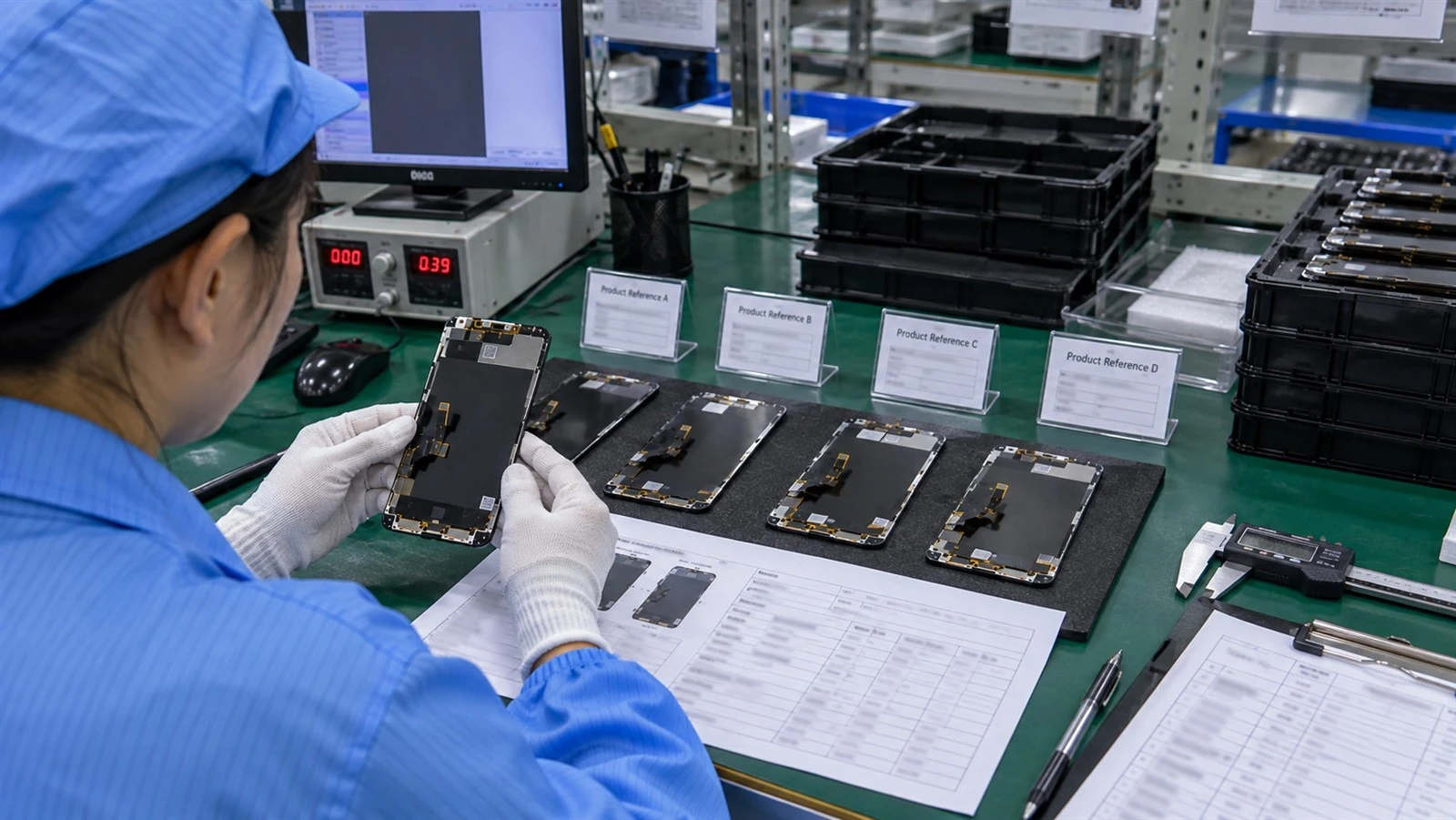
- What a strong answer should clarify. Which functional checks are performed (display function, touch response, and similar), which cosmetic checks are performed, at what production stage, how acceptance criteria are defined, how failed units are handled, whether results are recorded, and whether that record is traceable back to the batch or product reference.
- What evidence to request. A description of the checkpoints in the process, sample inspection records, or a documented pass/fail process. Buyers building their own receiving process often work from something close to an iPhone LCD incoming inspection checklist for this exact reason - if the categories a supplier describes don't overlap with what you'd check on arrival, that gap is worth asking about directly.
- What should not be assumed. Do not accept an unverified claim of 100% testing, a specific defect rate, or a specific pass rate at face value; ask what evidence backs the number, or whether it is a general statement. A sample that passes your own testing tells you about that unit's performance - it does not, by itself, confirm that the checkpoint the supplier described actually runs at the production stage they named.
- Buyer's next action. Ask your contact to get confirmation from the QC team and share the relevant inspection record. Assess the sample separately for product performance, and treat the two as answering different questions rather than one confirming the other.

5. Can you provide representative samples before a bulk order?
- Why it matters. This moves the evaluation from claims to a physical product you can check.
- What a strong answer should clarify. Whether the sample represents the intended bulk specification, whether the exact product reference is identified on the sample, whether it reflects the agreed configuration, what test criteria come with it, and whether any known differences between the sample and later production are disclosed upfront.
- What evidence to request. A sample tied to a specific product reference, along with whatever specification or test criteria the supplier can share alongside it. Buyers who want a structured way to test iPhone LCD samples before a bulk order generally check the sample against the same criteria they plan to apply to the bulk shipment, not a separate, looser standard.
- What should not be assumed. One good sample does not prove that every unit in a future bulk order will match it. The sample is one stage of verification, not final proof of long-term supplier performance.
- Buyer's next action. Write down what you expect the sample to prove before it arrives, so you're testing against a defined expectation rather than forming a general impression.
6. How do you control sample-to-bulk and batch-to-batch consistency?
- Why it matters. A good sample followed by an inconsistent bulk shipment creates real costs - rework, returns, and delayed deliveries - even when nothing else about the order went wrong.
- What a strong answer should clarify. How product revisions are controlled, whether component or process changes get recorded, how batch identity is maintained, how the specification is communicated to production and QC, whether changed materials or processes are disclosed when they happen, and how bulk product is checked against the approved reference sample.
- What evidence to request. A batch label, a revision record, an approved-sample record, an inspection record, a change-control document, or any product-reference history the supplier can share. Ask specifically how sample quality and bulk-order quality are kept aligned - a supplier who can point to a record for that, rather than a general assurance, is giving you something concrete to check later.
- What should not be assumed. Do not assume a formal change-control system exists just because the supplier answers confidently. If nothing in writing supports the claim, treat it as unconfirmed rather than assuming a process you have not seen.
- Buyer's next action. If no consistency record exists, treat sample-to-bulk alignment as unresolved and build a check for it into your trial order rather than assuming it going forward.

7. What is the MOQ, and can different iPhone models be mixed in one order?
- Why it matters. A stated MOQ can mean different things - a total-order minimum, a per-model minimum, or a per-product-reference minimum - and buyers who don't ask often misread the number.
- What a strong answer should clarify. Whether the MOQ applies to the total order, to each model, or to each product reference; whether models can be mixed within one order; and whether mixing model quantities changes the quotation terms.
- What evidence to request. A written order-structure explanation, ideally tied to a real quotation example rather than a generic statement.
- What should not be assumed. Not every supplier structures MOQ the same way, and a quantity threshold should never be assumed to carry over from one supplier's terms to another's.
- Buyer's next action. Apply the confirmed MOQ structure to your actual planned model mix before requesting a quotation, not after.
8. What determines your production or replenishment lead time?
- Why it matters. A single lead-time number, detached from order conditions, is not something you can plan around reliably.
- What a strong answer should clarify. Whether lead time depends on finished-stock availability, production scheduling, order quantity, model mix, product revision, packaging customization, or documentation requirements - and, specifically, when the clock starts and what milestone ends it.
- What evidence to request. A lead-time explanation tied to the actual order conditions you're asking about, not a general figure quoted before those conditions are known.
- What should not be assumed. Do not assume every delay is caused by material shortages, and do not treat a quoted lead time as fixed once order conditions change.
- Buyer's next action. Build your own delivery timeline around the confirmed start and end points, not around the headline number alone.
9. What warranty and defective-product process applies to wholesale orders?
Why it matters. This clarifies accountability before a problem occurs, rather than after.
- What a strong answer should clarify. What situations are covered, what is excluded, the claim period if one is specified, what evidence is required to file a claim, how the defect-report process works, whether installation-related damage is treated differently from a manufacturing defect, and what remedy structure applies - replacement, credit, or return logistics.
- What evidence to request. Written warranty terms, ideally the same terms that would apply to your actual order rather than a verbal summary.
- What should not be assumed. A longer stated warranty period does not automatically mean a better supplier; the process for actually using the warranty matters as much as its length.
- Buyer's next action. Get the warranty terms in writing before placing a trial order, not after a defect shows up.
10. What documents or records can you provide before or with an order?
- Why it matters. This question separates documents that support a claim from documents that simply look official.
- What a strong answer should clarify. Which of the following the supplier can provide where applicable: a product specification, a test or inspection record, a packing list, a batch reference, a product label, a quotation, commercial documents tied to the order, warranty terms, a sample report, or general company and factory information.
- What evidence to request. The documents themselves, tied to the specific product and order you're discussing.
- What should not be assumed. A packing list, an internal inspection record, and a quotation each support a different, narrower claim - none of them is a substitute for third-party certification, and none of them should be treated as one. Ask who issued each document, which product or order it covers, and what specific claim it backs up, rather than treating "we can send documents" as proof on its own.
- Buyer's next action. Ask for the documents relevant to your specific order, and record which ones the supplier says they can't provide - that gap matters as much as what they can.
11. Can we place a controlled trial order before scaling up?
- Why it matters. A trial order is a commercial verification step, not just a smaller purchase.
- What a strong answer should clarify. Whether a trial order is available at a defined, smaller quantity, and what it is meant to test - product consistency, packaging, order accuracy, communication, delivery execution, document quality, and how the supplier responds if something goes wrong.
- What evidence to request. Clear trial-order terms: quantity, specification, timeline, and what happens if the trial reveals a problem.
- What should not be assumed. A successful trial order does not prove indefinite future performance. It reduces uncertainty for one defined order under defined conditions.
- Buyer's next action. Define what "success" looks like for the trial order before it ships, so you have criteria to evaluate the result against, not just an impression of how it went.

12. What information do you need to issue an accurate wholesale quotation?
- Why it matters. "Send me your best price" is a weak RFQ because it leaves too much undefined for the number to mean anything comparable across suppliers.
- What a strong answer should clarify. What the supplier needs from you: models, quantity by model, target specification, quality or acceptance requirements, packaging requirements, private-label requirements if relevant, destination, delivery basis if known, sample requirement, documentation requirement, and warranty expectations.
- What evidence to request. A quotation that references the specific product reference and order conditions you provided, rather than a generic price list.
- What should not be assumed. A quotation without a defined product and order scope is not directly comparable to another supplier's quotation, even if the two numbers look similar. If you're requesting pricing on something like an iPhone SE (2020) replacement LCD screen, put the model, quantity, and target specification in the same message so the quote you get back is comparable to another supplier's.
- Buyer's next action. Send a complete request in one message rather than a partial one, and treat a quotation that skips your stated requirements as incomplete.
How to Compare Answers From Two iPhone LCD Manufacturers?
Use the same evaluation criteria for both suppliers. For each item, record the supplier's answer alongside the document, sample result, or order record that supports it. The table below explains what to capture; it does not report findings about any particular supplier.
| Evaluation Area | Supplier A - Information to Record | Supplier B - Information to Record | Unresolved Issue / Next Step |
|---|---|---|---|
| Manufacturing scope | Identify the processes performed in-house, outsourced, or handled through resale for the quoted product. Reference supporting process records or verified facility observations. | Record the same process boundaries for the equivalent product, with supporting records or observations. | Clarify who controls outsourced work and who is responsible for inspection and corrective action. |
| Product specification | Record the supplier SKU, compatible model, display technology, assembly configuration, revision, and specification document. | Record the equivalent details from this supplier's specification; keep its SKU separate from Supplier A's. | Resolve differences in technology, configuration, or acceptance criteria before comparing prices. |
| Quality-grade definition | Record the written performance and cosmetic criteria behind the quoted grade. | Record the criteria behind this supplier's grade, even if the grade name matches Supplier A's. | Compare criteria rather than grade names. Request clarification wherever a label lacks a documented definition. |
| QC process | Record the checks performed, production stages, acceptance criteria, testing coverage, and available batch-linked inspection records. | Record the same information, distinguishing checks applied to every unit from checks performed on sampled units. | Ask QC to clarify undocumented checks. Assess sample performance separately from evidence that the production process is followed. |
| Samples | Record the sample SKU, revision, configuration, sample ID, agreed test criteria, and any disclosed differences from bulk production. | Record the same sample details and evaluate them against the same buyer requirements. | Confirm sample representativeness and record test results before approving the product reference. |
| Batch consistency | Record how approved samples, specification revisions, component changes, and production batches are linked. | Record this supplier's traceability and change-notification arrangements, with supporting examples where available. | Define how trial-order units will be compared with the approved specification and sample. Keep unsupported consistency claims unconfirmed. |
| MOQ / mixed orders | Record the minimum quantity per SKU or model, the total-order minimum, and mixed-model conditions from a written quotation. | Record the same minimums and conditions for the proposed order mix. | Apply each supplier's terms to the same planned quantities. Confirm whether mixed orders affect per-SKU minimums or pricing. |
| Lead time basis | Record the quoted duration, its start and end milestones, applicable order conditions, and whether transport is included. | Record the same timing details, separating production, dispatch, and delivery where applicable. | Compare equivalent milestones. Clarify which changes in quantity, specification, or packaging would change the estimate. |
| Warranty | Record coverage, exclusions, claim deadline and start point, required evidence, available remedies, and responsibility for return freight. | Record the equivalent terms and any different treatment of installation damage or manufacturing defects. | Resolve unclear claim procedures and costs before ordering. Confirm that the written terms apply to the proposed purchase. |
| Documents | List the relevant documents received, including issuer, date, product or order reference, and verification status. | Maintain a separate document list using the same fields. | Distinguish documents received from documents checked. Identify any missing evidence needed to assess a material order requirement. |
| Trial order | Record the proposed SKUs, quantities, specifications, timing, evaluation criteria, and procedure for handling discrepancies. | Record trial terms that allow the same buyer requirements to be evaluated. | Agree on acceptance criteria before shipment and review the trial results before increasing quantities. |
| Quotation requirements | Record the quote number and date, product scope, quantities, currency, payment terms, delivery basis, validity, and stated inclusions or exclusions. | Record the same fields for an equivalent product and order scope. | Request a revised quotation where assumptions differ. Compare the costs and obligations included, not the unit price alone. |
Mark missing information as Not provided and unchecked material as Received - Not Yet Checked. Use Confirmed only for the specific claim supported by evidence you have reviewed.
Choose the next action based on the remaining uncertainty: request clarification, check a document, test a sample, or evaluate a controlled trial order. A polished response is useful only when the important claims behind it can be checked.
The difference shows up most clearly in wording. This is illustrative phrasing, not a real supplier's answer:
| Answer type | Example |
|---|---|
| Too vague to act on | "We test every screen before it ships." |
| Specific enough to follow up on | "For this product reference, we run a functional check and a cosmetic check at final assembly, log the result against the batch number, and can share a sample inspection record for the last shipment of this model." |
The second version gives you something concrete to ask for next - a batch number, a record, a named check. The first doesn't.

What Strong Supplier Answers Have in Common?
A strong answer tends to share a few traits:
- Specific and product-linked - tied to an exact product reference, not a general category
- Backed by evidence - a document, record, or result you can check, not just an assurance
- Consistent with what you've already seen - matching the sample, the stated specification, and earlier production
- Clear about limits and ownership - honest about what's excluded, and traceable to someone who can be held accountable for it
Not every piece of information should be expected instantly. Some commercially sensitive or customer-specific details reasonably require context before a supplier shares them. The real question isn't whether everything gets disclosed on the first message - it's whether the claims that matter to your order can be substantiated when you ask.
Red Flags Are Not the Same as Missing Information
A missing answer is not automatically proof that a supplier is unreliable. It can mean the sales contact genuinely doesn't have the information, the question needs to go to QC or engineering, your requirement wasn't stated clearly enough, the supplier doesn't formally document that particular area, or the claim simply needs to be verified at the sample or trial stage rather than answered over chat.
A stronger warning sign looks different: contradictory answers to the same question asked twice, a product description that changes between messages, unwillingness to identify the exact product reference being quoted, unsupported universal claims ("we never have defects," "our quality is the same as original" with no evidence behind it), refusal of reasonable product-linked verification, inconsistent information between the sample, the quotation, and the stated specification, or vague responsibility when you ask directly who handles a defective batch.
What to Prepare Before Contacting a Manufacturer?
Better questions produce better answers when your own requirement is already defined. Before reaching out, have ready:
- Target models
- Approximate quantities by model
- Target product specification
- Quality requirements
- Packaging requirements
- Destination market
- Sample needs
- Expected purchase timing
- Any documentation you'll require
- Your own warranty expectations
Frequently Asked Questions
What should buyers verify first when contacting a new iPhone LCD manufacturer?
Start with manufacturing scope - which processes the supplier controls for the specific product you're asking about - before moving on to specification, QC, and commercial terms. Everything else is easier to evaluate once that's clear.
Is a factory photo enough to verify an LCD manufacturer?
No. A photo can be old, borrowed from another facility, staged, or edited, and it doesn't by itself tell you which processes happen there or how consistent the output is. Ask where and when it was taken and how it connects to your quoted product, and treat it as one data point to check alongside a live video call, production records, or a site visit - not as verification on its own.
Should buyers request samples before placing a bulk order?
Yes, and the sample should be tied to the exact product reference and specification you intend to order, with test criteria you can apply consistently - otherwise the sample tells you less than it appears to.
How can buyers verify sample-to-bulk consistency?
Ask what record ties an approved sample to later production batches, and treat the absence of that record as something to confirm during a trial order rather than something to assume away.
What should be confirmed about MOQ and mixed-model orders?
Whether the MOQ applies per order, per model, or per product reference, and whether mixing models changes the quotation terms - these three details vary by supplier and are easy to misread if not asked directly.
What information does a manufacturer need for an accurate quotation?
Models, quantity by model, target specification, quality requirements, packaging requirements, destination, and any sample or documentation needs - sent together in one request rather than gathered piecemeal.
Next Steps Before Ordering
None of these 12 questions are meant to be asked once and filed away. Each one produces an answer that should carry into the next stage - the sample you request, the batch record you ask to see, the trial order you define, and the quotation you eventually compare against another supplier's. A supplier's answer isn't worth more because it sounds confident. It's worth more when you can connect it to a defined product, a defined process, and something you can check.
When you're ready to move past the interview stage, put what you've confirmed into one message - the models and quantities involved, the specification you've verified, and any documentation or sample results you're still waiting on. Use that summary to request the current model list, specifications, and sample policy and move the conversation into that next stage.