
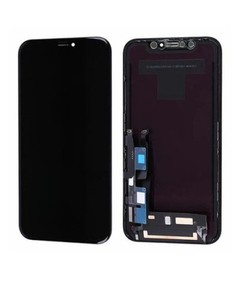



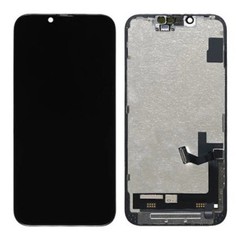
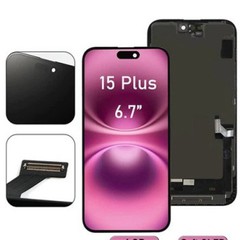


How to Calculate the True Procurement Cost?
A buyer receives two quotations for the same iPhone model. One is lower per screen. The other is higher, with different packaging and delivery terms. Which one costs less?
The unit price alone cannot answer that. To calculate the true cost of an iPhone LCD order, first align the model, configuration, delivery scope and evaluation period. Then total everything the buyer pays for that order: product, freight, import charges, payment fees, inspection, and the follow-up costs the buyer bears after acceptance. Subtract only the recoveries already received, without counting any item twice. Divide the result by the number of screens that passed initial acceptance.
This article walks through iPhone LCD procurement cost step by step, with formulas, a fillable worksheet, a worked example and the inputs an itemized quotation needs. It is written for wholesalers, distributors, importers and repair chains buying iPhone LCD screens in volume.

What Does True Procurement Cost Include?
A quotation answers one question: what does the supplier charge, under stated terms, for a stated product? A buyer approving an order needs a wider answer. The same screens also carry freight, import handling, payment charges and inspection time, and later they may carry repeat work on screens that fail in use. These are the hidden costs of buying iPhone LCD screens in bulk, and they become visible only when each one is assigned to a defined boundary.
| Measure | Question it answers | What it includes |
|---|---|---|
| Quoted unit price | What does the supplier charge per screen under the stated terms? | Only what the quotation says is included. Do not assume freight, duties, taxes or payment charges are in it. |
| Landed cost | What did it cost to bring the goods to the named receiving point? | Product cost plus transport and applicable import charges, inside a boundary the buyer writes down. Companies define it differently. |
| True procurement cost | What did this order cost the buyer over the evaluation period? | Landed cost plus buyer inspection, later quality handling, holding and funding costs, less recoveries actually received. |
True procurement cost, as used here, is a decision model rather than an accounting rule. It does not replace your finance team's valuation method. Its job is narrower: to compare order options on the same terms and to show the total procurement cost of iPhone LCD screens before the order is approved.
A consistent cost model supports the broader iPhone LCD wholesale sourcing process by making the buyer's total exposure visible before an order is approved.
For the comparison to hold, fix the evaluation boundary first: one batch or order, one settlement currency, one receiving location, one delivery scope, one set of acceptance criteria and one observation period, such as 90 days after incoming inspection. Label every figure as actual, estimated or scenario, so that a forecast is never read as a result.
Put Supplier Quotes on the Same Basis
Comparison starts before the arithmetic. Lock these items for every offer:
- the full model name, and the actual screen type and configuration
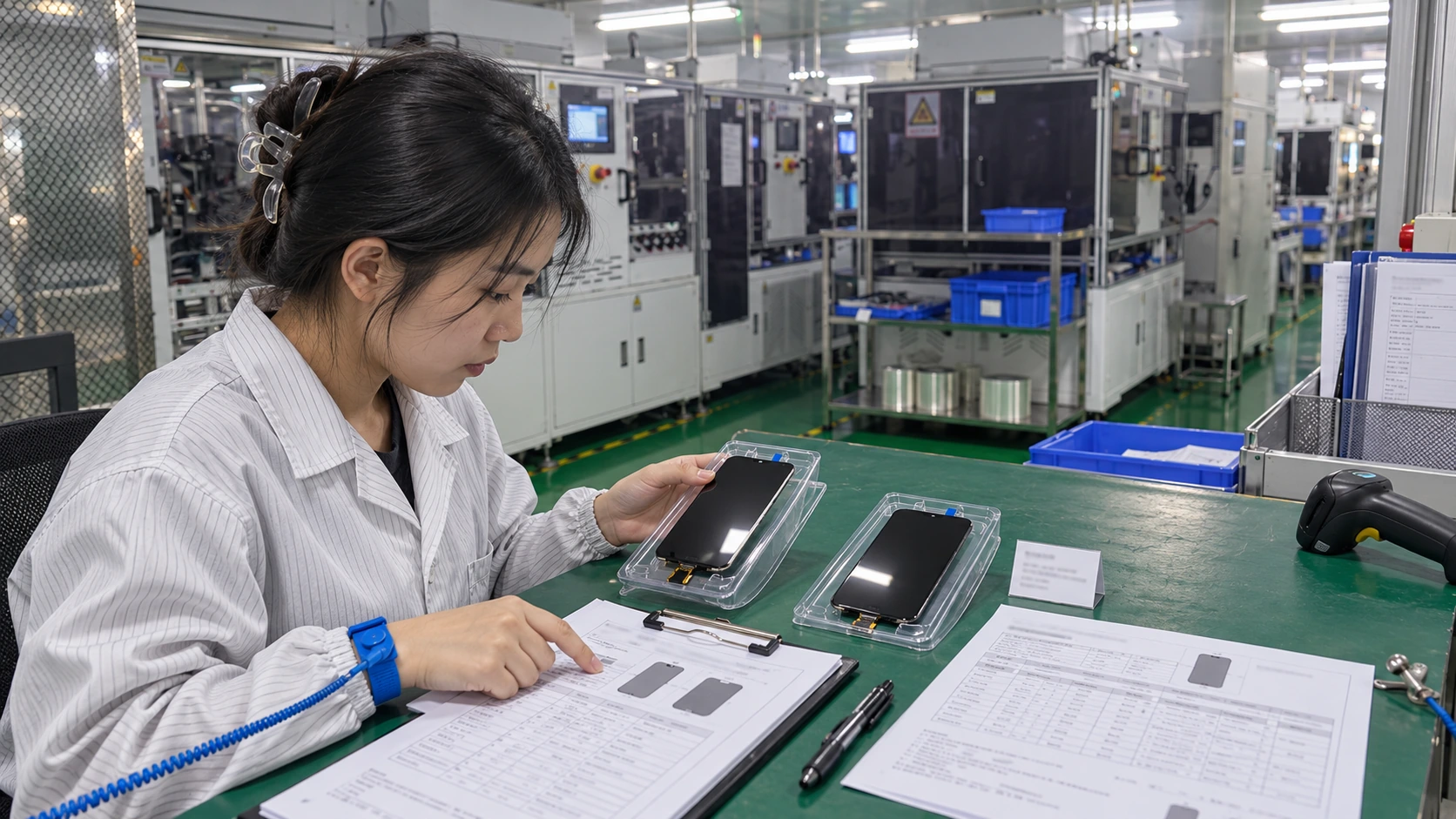
- acceptance criteria and test method
- quantity per model
- packaging and carton quantity
- currency, quotation validity and payment terms
- destination city, and the delivery term with its named place
A grade name such as "AAA" does not make two quotations comparable. Suppliers use the label differently, so the same word can sit on different configurations, tests and acceptance expectations. Equal budgets do not make offers comparable either, because the same amount of money may buy different quantities or different quality levels. Compare cost per defined unit under defined conditions.
When comparing iPhone LCD factory quotations, record the currency, delivery scope and packaging basis before adding buyer-side costs. Until the missing scope is clarified, treat any apparent price advantage as unconfirmed.
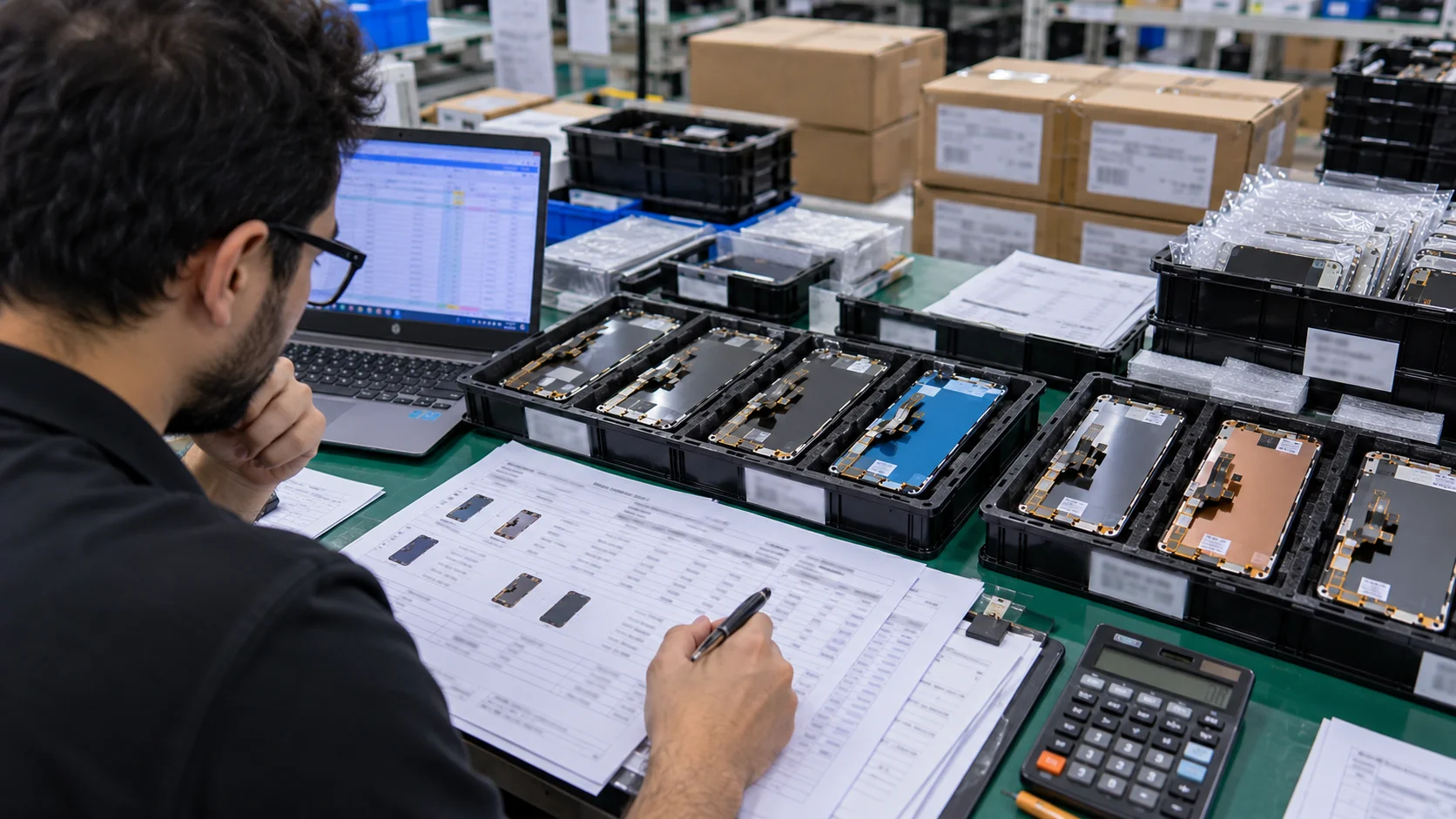
Record the approved iPhone 11 series Incell LCD configurations by exact model before their quoted prices enter the worksheet. Different configurations or display technologies can still be compared as options for a customer's needs, but they should be labeled as different products, not presented as a like-for-like price comparison.
Delivery terms deserve the same care. A trade term is meaningful only with its named place and the list of charges the quotation includes. "Door-to-door" does not automatically mean duties, taxes and clearance charges are covered. Write down what is included, what is excluded and who pays for each excluded item.

Build a Cost Worksheet Before You Compare
The completed worksheet below uses the same illustrative inputs as the worked example. Amounts are in CU, a teaching currency unit, not a real currency or market quotation. Supplier A and Supplier B represent hypothetical options.
"Additional" means a cost is added separately to the product price. "Unconfirmed" identifies information the example does not provide; it does not mean zero.
| Cost item | Supplier A: amount and status | Supplier B: amount and status | Evidence or assumption |
|---|---|---|---|
| Comparison basis | - | - | Illustrative inputs only |
| Exact model and configuration | Same model and configuration; exact SKU unspecified | Same model and configuration; exact SKU unspecified | Like-for-like products assumed for teaching; confirm actual specifications before purchasing |
| Currency, rate direction and rate date | CU; exchange rate and date n/a | CU; exchange rate and date n/a | No currency conversion in this example |
| Destination and delivery term with named place | Same receiving point assumed; named location and trade term unconfirmed | Same receiving point assumed; named location and trade term unconfirmed | Use the same delivery boundary; obtain actual destination and delivery terms for a live comparison |
| Evaluation period | 90 days after incoming inspection | 90 days after incoming inspection | Same observation period for both options |
| Product | - | - | Product cost is counted once |
| Quantity and quoted unit price, by SKU | 1,000 screens × 18.00 CU | 1,000 screens × 18.60 CU | One hypothetical SKU per option |
| Product cost | 18,000 CU; base amount | 18,600 CU; base amount | Quantity × unit price |
| Packaging and one-time charges | - | - | No separate amount appears in the worked example |
| Packaging and labels | No separate charge modeled; actual inclusion unconfirmed | No separate charge modeled; actual inclusion unconfirmed | Confirm packaging scope and whether it is included in the unit price |
| Setup or sample charges allocated to this order | 0 CU allocated; teaching assumption | 0 CU allocated; teaching assumption | No setup or sample allocation is modeled; this does not imply free samples |
| Transport | - | - | Count only charges outside the product price |
| Pickup, export handling, main freight, insurance and final delivery | 900 CU; additional aggregate transport allowance | 900 CU; additional aggregate transport allowance | Teaching input; individual charges and insurance scope are not specified |
| Import and payment | - | - | Illustrative allowances, not destination-specific rates |
| Nonrecoverable import charges and clearance service fees | 400 CU; additional | 400 CU; additional | Assumed aggregate amount; not a tax or duty quotation |
| Transfer fees and currency conversion cost | 200 CU; additional payment-fee allowance | 200 CU; additional payment-fee allowance | No exchange conversion is modeled; do not add a second conversion allowance |
| Inspection | - | - | Buyer-side cost only |
| Buyer incoming inspection and external inspection | 300 CU; additional combined allowance | 300 CU; additional combined allowance | No split between internal and external inspection is provided |
| Quantities | - | - | Initial acceptance results |
| Units received | 1,000 screens | 1,000 screens | Assumed equal to paid quantities; no short shipment modeled |
| Unique units unusable at acceptance | 40 screens | 15 screens | Deduplicated teaching inputs, not supplier defect-rate claims |
| Initially usable units | 960 screens | 985 screens | Received units minus unique unusable units |
| After acceptance | - | - | Incremental buyer-borne costs during the evaluation period |
| Repeat labor, return freight, reshipment, replacement purchases and ticket handling | 700 CU; additional aggregate allowance | 150 CU; additional aggregate allowance | Component amounts are unspecified; original product cost is not added again |
| Inventory and funding | - | - | The example provides a combined amount only |
| Incremental storage and handling cost | Separate amount unconfirmed; part of the 200 CU combined allowance below | Separate amount unconfirmed; part of the 100 CU combined allowance below | Excludes purchase value already counted in product cost |
| Financing cost | Separate amount unconfirmed; part of the 200 CU combined allowance below | Separate amount unconfirmed; part of the 100 CU combined allowance below | No second funding charge is added |
| Combined storage, handling and financing allowance | 200 CU; additional, counted once | 100 CU; additional, counted once | Use this combined row in the example total; do not also sum the two component rows |
| Recoveries | - | - | Cash received during the evaluation period |
| Refunds and compensation payments actually received | 0 CU | 0 CU | No realized recovery is assumed |
| Credit notes and pending claims | None modeled; excluded from recovery deduction | None modeled; excluded from recovery deduction | Do not treat an expected recovery as cash already received |
| Calculated results | - | - | Subtotals and metrics below are outputs, not additional cost lines |
| Landed cost, excluding buyer inspection | 19,500 CU | 20,100 CU | Product + transport + import/handling + payment fees |
| Base procurement cost, including inspection | 19,800 CU | 20,400 CU | Landed cost + buyer inspection |
| True procurement cost over the period | 20,700 CU | 20,650 CU | Base + after-sales + combined inventory/funding allowance − realized recoveries |
| Landed cost per received screen | 19.50 CU | 20.10 CU | Landed cost ÷ 1,000 received screens |
| Base cost per initially usable screen | 20.63 CU | 20.71 CU | Base cost ÷ initially usable screens |
| True procurement cost per initially usable screen | 21.56 CU | 20.96 CU | True procurement cost ÷ initially usable screens |
These totals reproduce the teaching example. They are not verified purchasing totals: the exact SKU, destination, delivery terms and packaging scope remain unspecified.
For a live order, replace the assumptions with quotation lines, freight estimates, inspection records and buyer-side cost records. Keep numeric amounts and status labels in separate spreadsheet fields. Sum only the underlying cost lines; do not add subtotals, calculated metrics or the individual inventory/funding components again.

Calculate Cost per Usable Screen
Define each input before using it:
- Q: paid screens actually received. If this differs from the quantity ordered or paid, reconcile the difference separately.
- C_landed: total cost to the receiving point, inside your stated boundary. For a mixed order, build it model by model.
- C_base: C_landed plus the buyer's evaluation and acceptance inspection cost.
- Q_unusable: unique screens unusable at acceptance.
- Q_usable: Q − Q_unusable.
- C_after: buyer-borne after-sales cost incurred or explicitly estimated during the period.
- C_inventory: incremental storage and inventory-handling cost for the period, excluding purchase value already counted in product cost.
- C_finance: funding cost not already counted elsewhere.
- R: refunds or compensation payments actually received during the evaluation period and not already deducted elsewhere.
Landed cost per received unit = C_landed / Q
Base cost per usable screen = C_base / Q_usable
True procurement cost over the evaluation period = C_base + C_after + C_inventory + C_finance - R
True procurement cost per initially usable screen = True procurement cost over the evaluation period / Q_usable
The first formula shows what a delivered screen cost before anyone knows whether it works. The second gives the cost per usable iPhone LCD screen at acceptance. The third and fourth add what the buyer bore afterward, first as a total and then per screen. Keep all four measures, because they answer different questions and can rank two offers differently.
The final metric treats the screens that passed initial acceptance as a fixed base. Later warranty replacements raise the numerator when the buyer bears a cost, but they do not shrink the denominator and are not counted as new purchases. If you prefer a "net sellable units" model, rebuild the denominator and every cost line together; do not mix the two methods in one calculation.
Paid screens that fail acceptance are already inside the product cost. Removing them from the denominator raises the cost per usable screen, and adding their purchase price to the numerator again would count the loss twice. Add only new outlays, such as extra testing, disposal, or a replacement screen the buyer bought elsewhere.
Use these rules to avoid double counting:
- Charges already on the invoice, such as packaging or freight, are not added again.
- A screen damaged in transit that also fails a function test counts once.
- Manufacturing defects, transit damage, model mismatch and installation damage are recorded separately. Not every return is a supplier defect.
- If a holding-cost rate already contains funding cost, do not add C_finance for the same money.
- Do not add the purchase value of written-off or marked-down stock again, because it is already in product cost. Track lost sales and markdown losses as a separate commercial-loss measure rather than inside this procurement cost.
Every denominator must be above zero. If Q_usable is zero, report that cost per usable screen cannot be calculated and treat the batch as a failure case; do not report a cost of zero.
Worked Example: Compare Two LCD Procurement Options
Illustrative example only-not a supplier quotation, factory performance record or market benchmark.
Assume two options for the same model, the same verified configuration and the same delivery boundary. Each option delivers 1,000 paid screens. Amounts are in CU, a teaching currency unit that stands for no real currency or current price. The evaluation period is 90 days after incoming inspection.
| Item | Option A | Option B |
|---|---|---|
| Paid units received | 1,000 | 1,000 |
| Quoted unit price (CU) | 18.00 | 18.60 |
| Product cost (CU) | 18,000 | 18,600 |
| Additional freight and delivery (CU) | 900 | 900 |
| Illustrative nonrecoverable import/handling costs (CU) | 400 | 400 |
| Payment and conversion fees (CU) | 200 | 200 |
| Buyer inspection cost (CU) | 300 | 300 |
| Landed cost, excluding buyer inspection (CU) | 19,500 | 20,100 |
| Base procurement cost, including inspection (CU) | 19,800 | 20,400 |
| Unique units unusable at initial acceptance | 40 | 15 |
| Initially usable units | 960 | 985 |
| Later buyer-borne incremental after-sales cost (CU) | 700 | 150 |
| Inventory and financing cost, combined with no overlap (CU) | 200 | 100 |
| Separately realized recoveries (CU) | 0 | 0 |
| True procurement cost over the period (CU) | 20,700 | 20,650 |
| Base cost per initially usable screen (CU) | 20.63 | 20.71 |
| True procurement cost per initially usable screen (CU) | 21.56 | 20.96 |
The unusable counts of 40 and 15 are deduplicated figures assumed for teaching. They are not defect rates for any supplier, and they are not necessarily manufacturing defects.
Landed cost per received unit is 19.50 CU for Option A and 20.10 CU for Option B, so A looks cheaper by 0.60 CU before inspection. After acceptance, A's base cost per usable screen is 20.63 CU (19,800 ÷ 960) and B's is 20.71 CU (20,400 ÷ 985). A still leads, narrowly.
Adding the later buyer-borne cost and the holding cost reverses the order. A's true procurement cost is 19,800 + 700 + 200 = 20,700 CU, and B's is 20,400 + 150 + 100 = 20,650 CU. Per initially usable screen, that is 21.56 CU for A against 20.96 CU for B.
The ranking reverses because A's extra acceptance losses and later buyer-borne costs outweigh its lower purchase price. If acceptance and follow-up costs were equal, A's lower price would give it the lower cost, as the equal-cost scenario below shows.

Account for Returns, Warranty Recovery and Cash Timing
A warranty changes who bears a cost; it rarely makes the cost zero. Start by separating three kinds of after-sales cost: the screen itself, the labor to fit it again, and the freight to move it back and forth. Each can be treated differently under the agreed terms.
The amount a buyer can recover depends on the agreed B2B LCD warranty coverage and claim terms, while additional labor and freight remain separate cost items. A free replacement screen does not by itself cover repeat installation labor, return shipping or customer service time.
Record the cause of each return before assigning it: manufacturing defect, transit damage, model mismatch or installation damage. The cause decides whether a claim exists, and the claim decides what can be recovered. An installation-damaged screen is a real cost to the buyer, but it may not be a recoverable one, so not every return belongs on the supplier's side of the ledger.
Treat each recovery according to its status:
| Status | How to treat it |
|---|---|
| Refund or compensation payment received | Include in R for this period |
| Credit note usable on a later order | Show separately with amount, conditions and expiry; it is not a cash recovery for this order |
| Claim submitted, not approved | Use as a scenario only, never as a realized recovery |
| Free replacement units | Under this fixed-denominator model, assign no separate purchase cost or recovery deduction to them. Record buyer-paid freight, testing and handling as after-sales cost, and do not add the units to the usable-screen denominator |
If you use a net after-sales figure that already deducts compensation, do not deduct the same compensation again through R. A refund, a credit and the value of a replacement screen are three ways of compensating one loss; count the loss once.
Timing matters for cash. A credit note that can only be used on the next order does not reduce what you pay for this one, and a refund that arrives months later raises the funding cost. Put the amount, the condition and the expected date next to each recovery line.

Allocate Mixed-Model Costs and Test Your Assumptions
Calculate a mixed-model order model by model. An order average can hide a SKU that is far more expensive per usable screen than the rest, because a model with a higher unusable count, a heavier carton or slow sales disappears inside a blended figure.
The agreed iPhone LCD MOQ and mixed-model order requirements determine the quantities purchased and the cash committed to each SKU. Per-model minimums and full-carton quantities can push slower models above what you expect to sell within the holding period, which raises storage and funding cost even when the quoted unit price falls.
Shared costs should follow a sensible driver:
- Freight: by chargeable weight or volume, as the carrier bills it.
- Inspection labor: by the time actually spent on each model.
- Charges billed on value, such as some insurance or payment fees: by product value.
- One-time charges: by order first, then by value or units, with the basis stated.
Dividing total cost by total pieces without a stated reason distorts the result when models differ in size and price. When driver data is missing, write down the assumption you used.
List every approved iPhone 16 Incell LCD replacement screen configuration as its own SKU, so that one configuration's acceptance result is never carried over to another model or variant.
Before you trust a ranking, test the assumptions. Change one input, or one clearly named group of inputs, and keep everything else at the base values. The table below keeps the example's quoted prices and landed costs fixed.
| Scenario | What changes | Option A (CU per initially usable screen) | Option B (CU per initially usable screen) |
|---|---|---|---|
| Base | Example inputs as shown above | 21.56 | 20.96 |
| Low after-sales cost | Buyer-borne after-sales cost halves: A 350, B 75 | 21.20 | 20.89 |
| High after-sales cost | Buyer-borne after-sales cost doubles: A 1,400, B 300 | 22.29 | 21.12 |
| Equal acceptance and follow-up costs | A matches B on unusable units (15), after-sales cost (150) and inventory and financing cost (100) | 20.36 | 20.96 |
The halved and doubled values are test settings, not forecasts. With every other base input unchanged, Option A's after-sales cost would need to fall to about 126 CU or less to match Option B's 20.96 CU per screen. A break-even point like this is valid only when both options are solved on the same basis, and it does not show that either option is always better.
Test the usable rate, freight, holding time and the timing of recoveries the same way, one change at a time.

Procurement Cost FAQs
Can I compare suppliers if one quote is in RMB and another is in USD?
Yes, after converting both to one currency. Use the same rate direction and the same conversion date for every offer, and note how long each quotation stays valid. If you will pay in a currency different from the quoted one, include the actual conversion cost once.
How should I estimate defect-related costs for a new supplier?
Use low, base and high scenarios and label them as assumptions. State what the event rate is divided by, the quantity it covers, the observation period and whether affected units are deduplicated. A small sample result is not a stable batch rate, and return rates measured over different periods or definitions cannot be compared directly.
Should recoverable import VAT be treated as a permanent procurement cost?
Not automatically. Recoverable import tax may affect the cash you need and the funding cost, but it is not necessarily a permanent economic cost. Nonrecoverable charges belong in the model. How each item is treated depends on your jurisdiction and tax status, so confirm it with your tax adviser or customs broker.
Does a warranty credit reduce the cash needed for the current order?
No. A credit that can only be used on a later order does not reduce what you pay now. Show its amount, conditions and timing separately. Only refunds or compensation payments actually received count as recoveries for this order.
Should I divide cost by purchased, received or usable screen quantities?
Use each for its own purpose. Divide by received units for landed cost per received unit, and by initially usable units for cost per usable screen. Reconcile purchased, paid and received quantities first, and treat a zero usable quantity as a failed batch rather than a zero cost.
Can a larger order lower unit price but increase overall procurement risk?
Yes. A larger order can commit more cash, leave slower models in stock longer and raise exposure if a batch has problems. It may still be the better choice. Compare both order sizes on the same model, boundary and scenarios before deciding.
Prepare the Inputs for an Itemized LCD Quotation
The worksheet shows which numbers you still lack. Use an itemized quotation to confirm the supplier-controlled inputs, and prepare these details before you ask for one:
- business type and country
- destination city and postal code
- exact models and quantity per model
- Incell LCD configuration requirements
- packaging requirements
- target lead time
- delivery term and named place
- quotation currency
Ask the supplier to mark every line as included or excluded. Obtain freight and import estimates from the relevant service providers, and calculate inspection, labor, inventory and funding costs from your own records.
For an itemized iPhone LCD wholesale quotation, send your exact models, quantities, packaging requirements and destination city.
This approach is meant for wholesalers, distributors, importers and repair businesses buying in volume. It is not a pricing method for single-screen retail repair.